/init FORM//GRAPH Metanomicon

/init · Visual reference library

Form//
Graph

Find a form.
Give it a purpose.

References, visual studies and build recipes for interfaces. Understand a technique. Take a brief into your next project.

33Source notes
10Build recipes
03Original studies
Built in Ydefix Team repository ↗

Start here

A reference is only the beginning.

  1. 01 / Find

    A source worth keeping.

    Search by technique or project. Every note links back to its original source.

    Browse source notes ↗
  2. 02 / Translate

    A mechanism you can use.

    Recipes turn references into production steps, tools and constraints.

    Read a sample recipe ↗
  3. 03 / Build

    A brief for the next person.

    Copy a brief from a source or recipe. Give it to a collaborator or coding agent.

    Read the quick start ↗

01 / The library

The
atlas

Good references. Useful next steps. Sources are saved evidence. Recipes are our synthesis. Open a card for the original link, project fit and a copyable build brief.

33 source notes · 10 recipes. Use the controls to narrow the collection.

source-001 / Build systemSource note

Visual AI is shifting from pixels to code

Argues that useful visual AI should generate editable symbolic artifacts—HTML, SVG, Lottie, Blender scripts or USD scenes—then let a renderer produce pixels.

BlenderSVGLottieUSD
source-002 / Procedural formSource note

Tutorials | Learn how to create generative art

A broad tutorial index spanning kinetic code art, Three.js terrain, random walkers, Grasshopper, TouchDesigner, particle oceans and seamless noise loops.

p5.jsThree.jsTouchDesignerProcessing
source-003 / Shader / fieldSource note

A brief intro to WebGL shaders

Explains per-pixel fragment shaders through a dependency-free pointer reveal that mixes two images with uniforms and a noisy circular mask.

WebGLGLSLJavaScript
source-005 / Shader / fieldSource note

PRIMAL

Documents a layered system: topographic pixels are split into channels, textured by separate shaders, displaced, colored and recomposed under live control.

GLSLPythonRealtime controls
source-007 / Build systemSource note

Create your own shaders. Use them everywhere.

Presents prompt- or reference-derived generators with live parameters, layers and keyframes that export as editable SVG or high-resolution raster.

ShadersSVGFigmaAfter Effects
source-008 / Motion grammarSource note

Playground

A collection including a 3D ring of HTML slides passing through a shader portal and a form that lifts into an extruded dot-relief scene on focus.

Three.jsR3FHTML in canvas
source-009 / Visual craftSource note

Dither + glyph + mouse-trail effect breakdown

Shares a concrete layer order and settings for blue-noise dither, organic glyph conversion, a fluid mouse trail, chromatic noise displacement and light rays.

DitherGlyphsDisplacement
source-010 / Visual craftSource note

Introducing Video2Ascii

Introduces an open React component that converts video to ASCII art with WebGL, reverse engineered from a visual reference.

WebGLReactASCII
source-011 / ReferenceSource note

Making Software

A visual technical reference covering pixels, color spaces, blending, curves, rasterization, SVG filters, GPU fundamentals, signed-distance fields, noise and ray techniques.

SVGShadersColorSDF
source-012 / ReferenceSource note

Guidelines

Practical interface guidance on animation cost: limit large blurs, pause or unmount offscreen media, apply will-change temporarily and adapt to hardware and network.

CSSMotionPerformance
source-013 / Motion grammarSource note

GSAP

The animation toolkit spans CSS, SVG, canvas and WebGL, with scroll sequencing and responsive matchMedia support.

GSAPSVGCanvasWebGL
source-014 / Build systemSource note

Kimi K3 cinematic website prompt

A detailed production prompt for editorial scroll pacing, oversized type, connected scene transformations, responsive art direction and reduced-motion support.

KimiGSAPReactWebGL
source-015 / ReferenceSource note

Design details that feel like magic

An indexed collection of product details, transitions, easter eggs and small interactions across mobile and desktop interfaces.

MicrointeractionMotionUI
source-016 / Motion grammarSource note

Find animation opportunities

Introduces a workflow that searches an interface for places genuinely improved by motion and also identifies what should remain still.

Motion auditUI
source-018 / Build systemSource note

A Guide to Claude Code 2.0 and better coding agents

Includes a frontend-design skill focused on distinctive production interfaces, deliberate aesthetic choices and avoidance of generic AI-made patterns.

Agent skillFrontendCode
source-019 / ReferenceSource note

Recent Design

A frequently updated index of contemporary interface fragments including interactive cards, drawers, timelines, grids and scrolling treatments.

UIWebMotion
source-020 / ReferenceSource note

Hugo Duprez

A design-engineering portfolio spanning browser ray marching, Voronoi fractures, Gaussian splatting, a web level editor, pixel conversion and generated textures.

WebGPUVoronoiGaussian splatsPixel art
source-021 / Procedural formSource note

Exploring creative coding with Swift and SwiftUI

Frames Swift and Xcode as a creative-coding studio alongside Processing, p5.js and openFrameworks, with references to data-driven visual art.

SwiftUICreative codingData art
source-022 / ReferenceSource note

Post Internet

Includes a work that re-contextualizes user-made 3D models of remembered dreams together with the makers’ own accounts of translating memory into form.

3D archiveNarrativeWeb art
source-023 / Motion grammarSource note

Letter Swap

A text component that swaps letter copies vertically on hover, with forward-only and reversible ping-pong timeline modes.

TypographyHoverComponent
source-024 / Visual craftSource note

Halftone / Mosaic / Blur / Grain node study

Describes recreating a familiar Photoshop process as a live node stack—halftone, mosaic, blur and grain—with switches and adjustable values.

HalftoneMosaicBlurGrain
source-025 / Build systemSource note

How GLM-5.2 Beat Fable 5 at Website Design

Observes that more intricate generated sites vary typography, layout and animation effectively for marketing pages, while requiring longer generation time.

Coding modelFrontendMotion
source-026 / Build systemSource note

Prompt your ideas to life with Figma Make

Shows web references becoming editable Figma layers and points toward generation grounded in an existing design system.

FigmaEditable layersDesign system
source-027 / Procedural formSource note

Drawing Dynamic Models

Explores procedural computation through drawn forms; a repeat meta-node clones a part, exposes an index and lets later nodes transform each instance differently.

CrosscutMeta-nodesDrawingInstancing
source-028 / Procedural formSource note

What’s the shape of the text?

Maps rolling text-window embeddings through dimensionality reduction and renders the resulting semantic structure as an explorable Three.js form.

EmbeddingsUMAPThree.jsSemantic geometry
source-029 / Motion grammarSource note

Browser-native heart / scanner HUD experiment

A focused visual-direction session produced a beating heart, field-scanner interface, live ECG and synthesized sound directly in the browser.

HTMLHUDAudioIterative prompting
source-030 / ReferenceSource note

This is a motherfucking website

A deliberately blunt defense of fast, legible, semantic HTML and content that works without an ornamental interaction gauntlet.

Semantic HTMLLegibilityPerformanceAccessibility
source-031 / Build systemSource note

vgpu: shader tools designed for agents

The author describes a minimal WebGPU library with explicit control, shader syntax checks, headless rendering and build-time WGSL validation.

WebGPUWGSLVercelCLI
source-032 / Motion grammarSource note

From drawn geometry to programmable graphics

A tutorial moves from selected references to SVG geometry, separate particle and line systems, screenshot feedback and reusable animation parameters.

SVGThree.jsJavaScriptWebflow
Move to inspect / click to open / connections share a stack or category

    02 / Original studies

    The idea,
    made visible.

    Three works from the Metanomicon gallery. Each offers a visual direction to explore through a recipe.

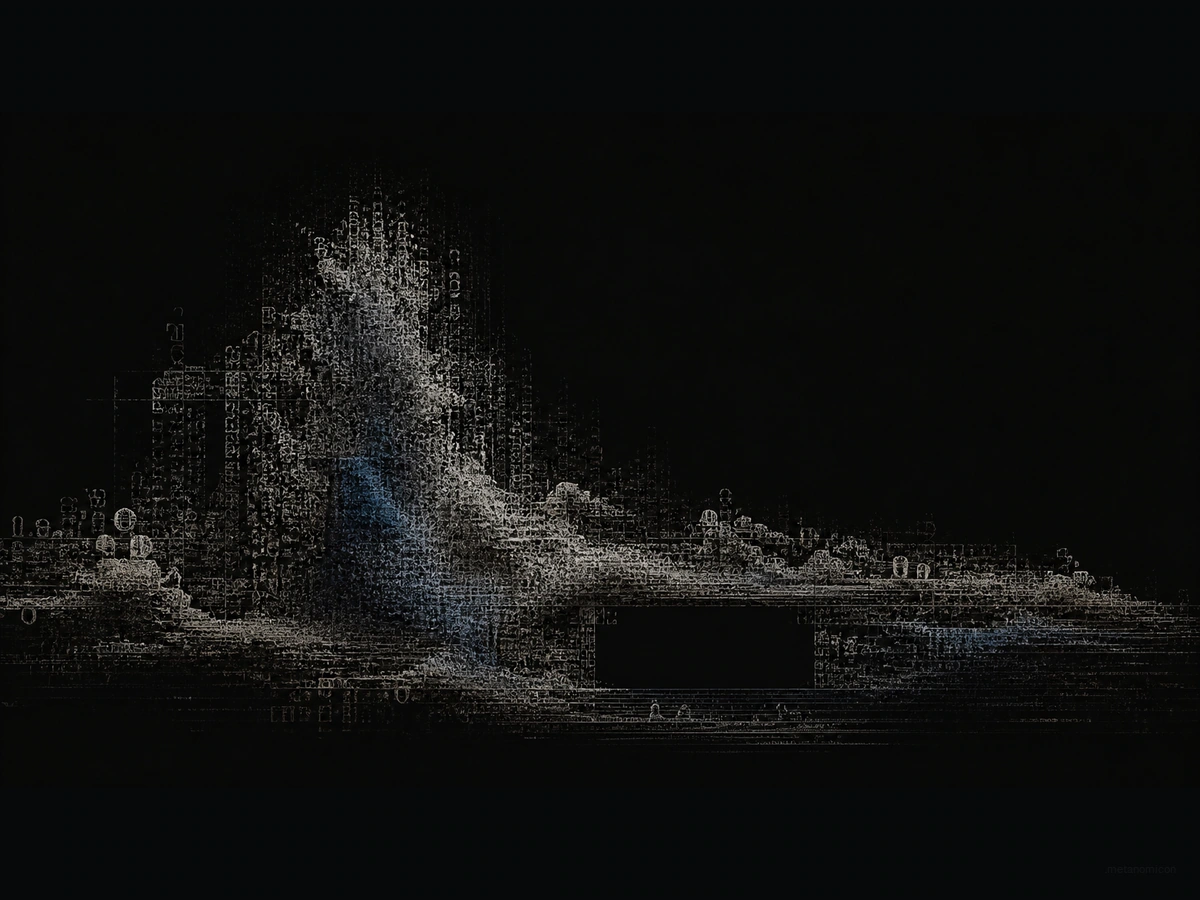
    Pale typographic fragments form a low landscape on a carbon field, interrupted by a dark rectangular opening.
    01 / Language becomes landscape

    Type weather

    An original Metanomicon AI-assisted study of language gathering into a landscape.

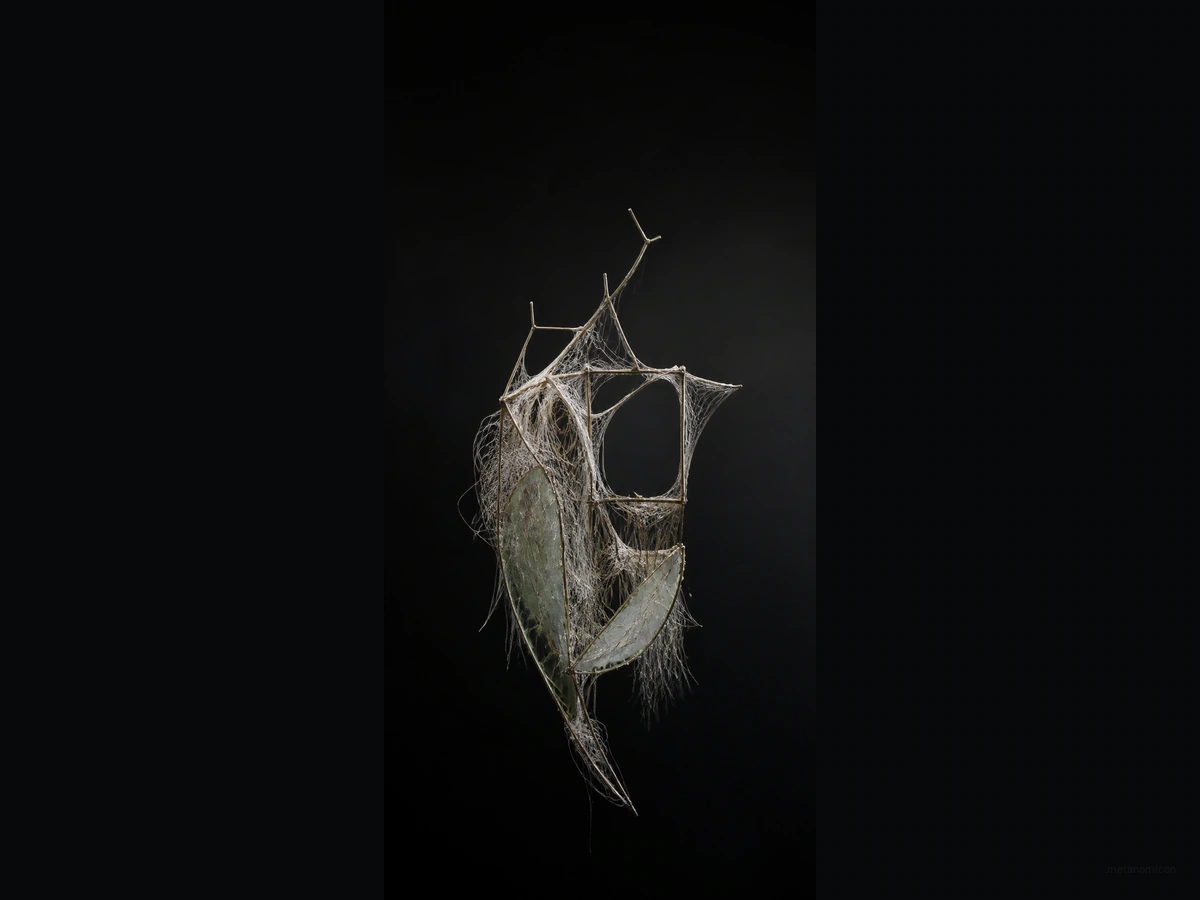
    A suspended frame of fine pale fibres and translucent mineral-green membranes against a dark background.
    02 / Material remembers tension

    Field specimen

    An original Metanomicon AI-assisted study of material, tension and the conditions held inside a form.

    Fine pale wave lines bend around a dark circular void on a black field.
    03 / State perturbs the field

    Interference

    An original Metanomicon AI-assisted study of a field reshaped around a changed center.

    Original Metanomicon AI-assisted studies. Visual research, not recipe output.Explore the gallery ↗Asset provenance ↗

    03 / Applications

    Give the form
    a job.

    Choose a direction. The atlas narrows to the references that can serve it.

    Research applications. These mappings describe where a technique could fit, not a claim of a shipped integration.

    Working principles

    From signal
    to surface

    Seven rules behind the work
    01
    Keep the source editable.

    Geometry, parameters, materials, timing and DOM remain the artifact—not only the final pixels.

    SOURCE→CODE
    02
    Give motion a narrative job.

    Reveal state, causality, scale or transition. If it does none of these, remove it.

    MOTION≠DECOR
    03
    Author high; ship lean.

    Blender and TouchDesigner discover the visual language. Web runtimes receive compressed geometry, textures, curves and rules.

    HQ→RUNTIME
    04
    Build the graceful failure first.

    Every live field owns a still, low-power and reduced-motion expression with the same composition.

    ART DIRECTION
    05
    Instrument, then curate.

    Expose seed, density, turbulence and palette. Save chosen states as named visual specimens.

    FIELD→SYSTEM
    06
    Keep a visible gap queue.

    The Reader corpus is rich in browser-native shaders and agentic visual workflows, but thin on deep Geometry Nodes, TouchDesigner network, SDF/raymarching and GPGPU curricula. Those stay marked for external sourcing—not disguised as retrieved evidence.

    GAP→QUEUE
    07
    Emit meaning, not surveillance.

    Signals name an intentional interaction and its public object. No pointer trails, search text, source content or personal data leaves the surface.

    INTENT→SIGNAL

    Reading room

    Read the field.

    33 source notes. 10 production recipes. A short guide for turning a reference into a useful brief.

    What is FORM//GRAPH?

    FORM//GRAPH is the visual systems atlas of /init: a collection of source notes and original production recipes connecting procedural geometry, shaders, motion and semantic interfaces.

    Which parts are evidence, and which are proposals?

    Source notes summarize retrieved references and link to the original when available. Build translations and recipes are FORM//GRAPH synthesis. Recipe budgets are design targets, not measured performance or proof of a completed implementation.

    How should an agent use the atlas?

    Start with the public JSON index, follow the canonical source and recipe pages, and keep source summaries distinct from editorial synthesis. Recheck the original reference before attributing a claim. The index contains public metadata, not private Reader records.

    Working on the system? Canonical GitHub repository · README · Handoff. These team documents require authorized GitHub access; the public guide above is open to everyone.

    Build brief copied